:format(webp))
Since 1 January 2016, the Ecodesign Directive has set specific requirements for the performance of ventilation units. These requirements apply to all EU countries.
Find yours the Ecodesign Directive here - where requirements are described in detail.
The requirements are divided into two main categories:
NRVU stands for Non-Residential Ventilation Unit, while RVU stands for Residential Ventilation Unit. Don't be confused by the use of the word residential as part of the definition. It is only the air volume that determines whether a unit is categorised as NRVU or RVU, not the area of application – see below.
*regardless of applicationarea with the exception of process ventilation (read more about this under NRVU units).
NRVU units are units with a nominal airflow above 1000 m³/h.
Directives
The requirements of the Ecodesign Directive primarily concern:
Fan power consumption (SFP)
The performance of the heat recovery used
Although the definition of the limit values for power consumption is somewhat complex, the minimum requirements for heat recovery are clearly defined and determined as follows:
From 2018: Plate heat exchangers at least 73%, but liquid-coupled batteries only 68%
As mentioned, the directive also sets requirements for the specific electricity consumption (SFP). This is described in a formula that depends on a number of factors – including the actual temperature efficiency.
VEX overview
To make it clear and easily accessible, EXHAUSTO has prepared a table with calculations based on a nominal operating point and reproduced the result as table values. This table contains data for the compact VEX programme. Find a link to the VEX overview at the bottom of the page.
Calculation programs
In our calculation programs, you can find out whether a specific unit meets the Ecodesign requirements at a specific operating point. All EXHAUSTO NRVU units comply with 2018 requirements.
The Ecodesign guidelines do not apply here
As a starting point for whether a ventilation system must comply with the Ecodesign Directive, one can say that:
Ventilation for people = is covered
Process ventilation = may be exempt
The Ecodesign guidelines do not normally apply to “clean” process ventilation, in corrosive environments, at air temperatures above 100°C and when transporting flammable gases and vapours.
Example of places where the Ecodesign requirements do not normally apply:
Industrial hood where the ventilation system does not also include room ventilation (for people)
Data centres, server rooms
Recirculation system (<10% outdoor air share)
RVU – units with nominal airflow below 250 m3/h.
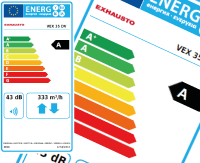
For small ventilation systems, there are requirements for energy labelling of the unit, as we know it from
refrigerators, for example. The requirements are primarily about information and energy labelling.
The following information is required:
|
|
In addition to the energy labelling of the unit, a lot of information must be made available both on the Internet and supplied with the unit. Based on the energy label, it is the idea that the customer finds the best solution in relation to energy consumption and price.
In contrast to the large units, BR18 still sets requirements for the temperature efficiency and, in addition, the specific electricity consumption for the entire installation, including pressure loss in ducts, fittings and roof hood, etc. as for the large units.
Requirements | 2018 |
SEC (specific energy consumption) | Less than -20 kWh/m3 x year |
Room sound power (LWa ) | 40 dB |
Variable speed drive | Minimum 3 steps or variable |
Bypass function |
Read more about:
Local Requirements
The individual EU countries’ requirements for temperature efficiency have been deleted and replaced by the requirements in the Ecodesign Directive, whereas the requirement for SEL/(SFP) still applies in many EU countries, as this requirement applies to the fully installed ventilation system, including pressure loss in ducts, fittings and roof hoods, etc., i.e. the finished installation.
Find an example of an Ecodesign declaration here
Thermal bypass
Filter warning | Visual signals |