- EXHAUSTO.com
- Products
- Air handling units
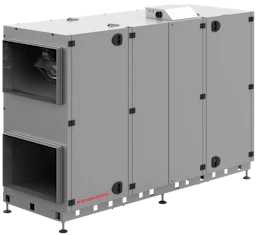
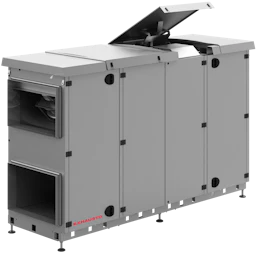
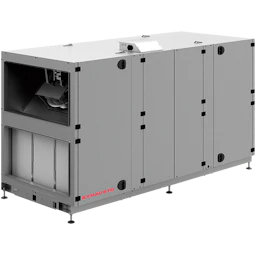
VEX350/360/370 is a series of ventilation units with counterflow heat exchangers. High temperature efficiency, and very low SFP and airflows of up to 9,200 m3/h

In principle, EXHAUSTO VEX units are designed for use in comfort ventilation - i.e. under ordinary operating conditions.
Where ventilation solutions are required for rooms with high air humidity - e.g. due to humidification, we recommend you make a test calculation with one of our calculation programs. If the calculation shows a risk of condensation after the heat exchanger, an assessment must be made whether the operating conditions can be changed, or whether the unit must be modified to allow condensate to drain off. This is particularly relevant for VEX100CF.
Contact EXHAUSTO for advice on this.
| Variants | ECO efficiency level during optimal operating point | Efficiency level requirements | Max. Total efficiency (A-D) (%) | Overload protection |
|---|---|---|---|---|
| VEX350H | 74,4N | 62N (2015) | 60 % | Built-in |
| VEX360H | 67,2N | 62N (2015) | 57,1 % | Built-in |
| VEX370H | 66,6N | 62N (2015) | 60,4 % | Built-in |
| Variants | Connection direction | Type of exchanger | Current overload protection | Motor class in accordance with IEC TS 60034-30-2 |
|---|---|---|---|---|
| VEX350H | Horizontal | Counterflow | Built-in | IE5 (Ultra Premium Efficiency) |
| VEX360H | Horizontal | Counterflow | Built-in | IE5 (Ultra Premium Efficiency) |
| VEX370H | Horizontal | Counterflow | Built-in | IE5 (Ultra Premium Efficiency) |
| Variants | Control signal with control system | Control signal with third party control system | Fluid temperature (air) | Regulation | Voltage input | Ambient temperature range |
|---|---|---|---|---|---|---|
| VEX350H | Modbus | 0-10 V DC | -40°C....+40°C | Variable via motor control (MC) | 1 x 230 V | -30°C....+50°C |
| VEX360H | Modbus | 0-10 V DC | -40°C....+40°C | Variable via motor control (MC) | 1 x 230 V | -30°C....+50°C |
| VEX370H | Modbus | 0-10 V DC | -40°C....+40°C | Variable via motor control (MC) | 3 x 400 V | -30°C....+50°C |
| Variants | A (mm) | B (mm) | C (mm) | Weight (kg) | Weight for transport |
|---|---|---|---|---|---|
| VEX350H | 2632 mm | 945 mm | 1904 mm | 635 kg | Heat exchanger section: 260 kg Fan section (qty. 2): 2 x 150 kg Base: 75 kg |
| VEX360H | 2932 mm | 945 mm | 1904 mm | 702 kg | Heat exchanger section: 310 kg Fan section (qty. 2): 2 x 156 kg Base: 80 kg |
| VEX370H | 3268 mm | 1366 mm | 1904 mm | 1018 kg | Heat exchanger section: 310 kg Fan section (qty. 2): 2 x 156 kg HCW-I heating coil (integrated): 58 kgBase: 80 kg |
| Variants | Max. airflow (m³/h) | Max. airflow ErP (m³/h) | Minimum airflow |
|---|---|---|---|
| VEX350H | 3820 m³/h | 3740 m³/h | 700 |
| VEX360H | 5360 m³/h | 4885 m³/h | 1100 |
| VEX370H | 8910 m³/h | 7800 m³/h | 1440 |
| Variants | Frequency (Hz) | Max. power of electrical coil 1 (kW) | Max. electrical output of unit (kW) | Voltage (V) | Max. power of electrical coil 2 | Maximum current - unit (A) | Max current of zero (A) |
|---|---|---|---|---|---|---|---|
| VEX350H | 50 Hz | 9 kW | 2,9 kW | 3x400 V | 24 | 11,2 A | 15 A |
| VEX360H | 50 Hz | 9 kW | 5,0 kW | 3x400 V | 24 | 18,0 A | 23,5 A |
| VEX370H | 50 Hz | 9,5 kW | 9,5 kW | 3x400 V | 17,5 A |

MECHANICAL PERFORMANCE:
According to ds/en 1886 and certified by Eurovent:
Structural strength: D1 (M)
Air tightness at negative pressure of -400 Pa: L1 (M)
Air tightness at positive pressure of +700 Pa: L1 (M)
Filter bypass leakage: F9 at negative and positive pressure
Thermal transmittance: T2 (M)
Thermal bridging factor: TB3

The cabinets are made of Aluzink AZ185 class C4 according to EN/ISO 12 944-2 and insulated with 50 mm mineral wool. This results in a low noise level to the surroundings/installation room.
The panel construction minimizes the formation of cold bridges in the unit.

The motor sections are mounted in vibration dampers, which means less noise and vibration in the ducts, and there is no need to install flexible connections between the unit and the duct system.
The motor sections are retractable for easier service.
The motors are of the EC type with very high efficiency, meeting the requirements of the EcoDesign directive.
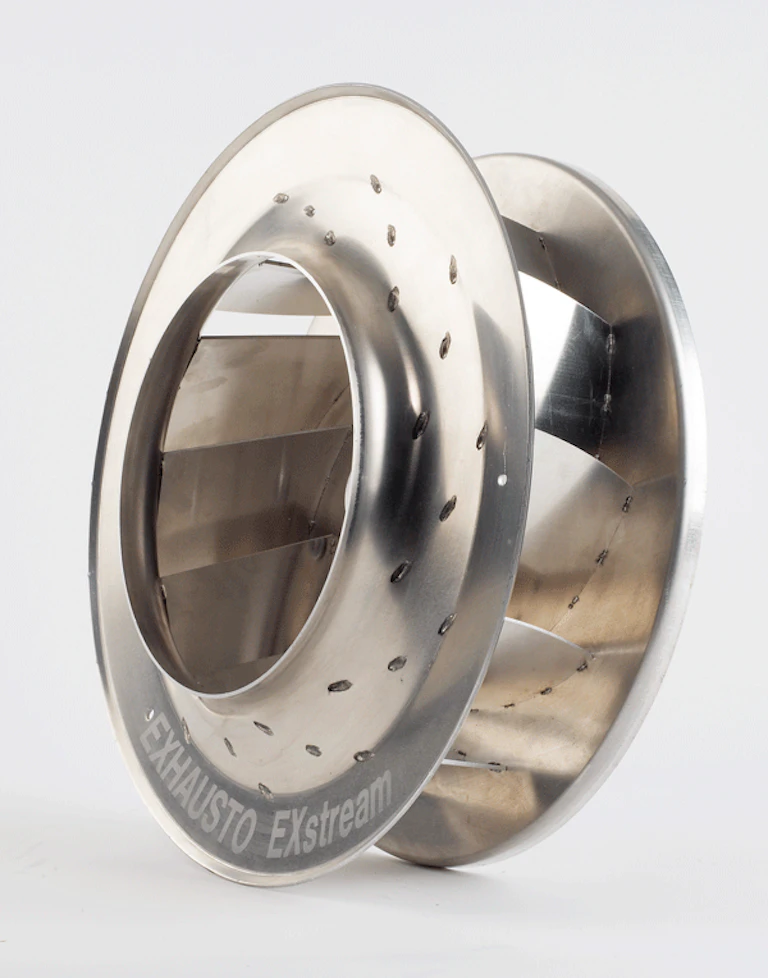
EXstream performance
The unit is equipped with EXHAUSTO's EXstream fan wheel, one of the market's leading fan wheels in terms of low energy consumption and low noise levels.
The fan wheel's rotation speed and number of blades are optimized so that noise from the "blade frequency" lies in the 500 Hz band. This means that fewer/smaller sound dampers are needed than usual, as it is cheaper to dampen the noise at 500 Hz than at 125 Hz/250 Hz, where the blade frequency normally lies.

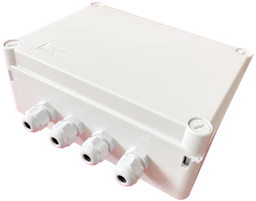
The easily accessible connection box with built-in switch disconnector and control system fuses ensures easy access for connecting and service.

VEX350-360-370 series can be supplied with panel filters and bag filters.
Panel filters: Coarse 85% (M5) or ePM1 55% (F7)
Bag filters: ePM10 60% (M5) or ePM1 60% (F7)
Included as standard is a mounting base with feet, which has an adjustable height of 130 - 160 mm.
The unit is assembled at the bottom using the base and via suitcase fittings at the top.
VEX350/360 are modular units, which means they are supplied in sections, so that the units can be transported through door openings as small as 900 x 2000 mm. The units can also be ordered as SPLIT models if there is insufficient room to transport them in sections.
VEX370 is also available as a modular construction and can be supplied in two different spilt versions.
SPLIT 1: The fan sections are supplied ready for operation but the heat exchanger section is not sealed and can be further split into two sections, so that all four sections can be transported through door openings of 900 x 2,000 mm.
SPLIT 2: For internal transport through smaller door openings order the VEX370 SPLIT 2 version. The whole unit is supplied not sealed and can be split into smaller sections so that it may be transported internally and then assembled on site by certified personnel.
The design of the units means that in transitional periods and during summer, air can be led around the heat exchanger, via the bypass when their is reduces demand or no demand for heat recovery. The unit has a bypass on both the extract air and supply air side. Extract air and outdoor air is filtered during summer and winter operation.
During summer time, operating without heat/cold recovery, both the outdoor air and the extract air is led around the heat exchanger via the bypass. This reduces internal pressure loss and the system uses less power for the ventilators and reduces the SFP value. In summer time, if cooling recovery is selected via the EXact2 control system, both air streams will be fed through the heat exchanger.
During wintertime operation with heat recovery, extract air enters at the top and is lead vertically down through the counterflow heat exchanger with any condensed water. The outdoor air enters from the bottom and runs up through the heat exchanger – i.e. a counter flow.
In the given example, the specific power consumption is reduced from 2000 J/m3 to 1823 J/m3 on average over the year. The average specific power consumption can be used in energy framework calculations. The reduction corresponds to a saving of about 9%, a not insignificant saving. The calculation is also highly dependent on the assumptions and should be calculated in each case using the product selection program EXselectPRO.
In the above example for residential ventilation, the assumptions were:
Exhaust air temperature/humidity: 22°C / 33% RH
Desired supply air temperature: 20°C
Temperature efficiency: 80%
Cooling recovery: Active
Energy calculations depend heavily on the current situation, such as expected exhaust air and desired supply air temperature. The energy consumption for de-icing is highly dependent on the humidity of the exhaust air. In residential buildings, icing of the heat exchangers typically begins at an outside temperature around -4°C to -6°C, whereas in offices there is usually no icing.
To minimize energy consumption for de-icing, it is important that ice formation is detected based on pressure drop measurement across the heat exchanger, as is the case with VEX350/VEX360/370.